How to teach dance figures? Right and Left through
How to teach the right and left through (or thru), quickly and efficiently?
Some think that figure dancing is more complex to teach than couple dances or dances in a round. Is it really harder to teach a quadrille than a circle dance?
It is partially true, as one needs to explain the move of 2, or even 8 dancers, at the same time. So, during the latest “teacher’s training” organized by my dance federation, figure dancing was at the end of the programme. Indeed, they were seen as “harder” than the other types of dance.
However, a complex figure doesn’t always require a long explanation. With some straightforward instructions, and a well-thought progression, one can make the beginners dance in a few minutes. Easy for me to say, you think, as I mainly teach figure dances: English country dances, quadrilles, square dances, longways, … The repertoire of figure dancing also includes folk dances from France, Ireland, Italy and many more. I surely didn’t think of all types of figure dancing, so feel free to complete the list in the commen area.
It is not only me that says it. After all, there are barn dances, ceili / ceilidh (and thei many spellings), dance evenings and balls… with ONLY figure dancing. And those events welcomes beginners dancers. Without need for long and verbose instructions. How do they do that? Do they always ask experienced dancers to show off the move? (no).
So, today, I will demonstrate a straightforward, fast, effective way to teach a complex figure: the right and left through. My method is to build the move progressively from an easier one.
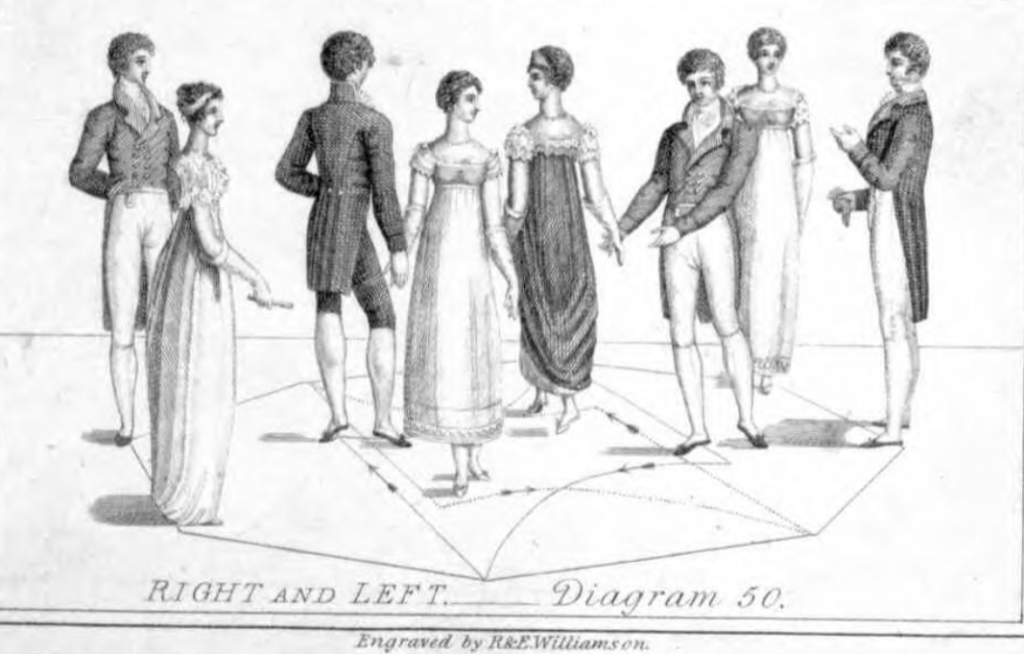
R. & E. Williamson, Londres, early 19th century, p.42.
Teaching the Grand Chain or Right and Left grand in a circle
First of all, you’re going to start by forgetting that name. When you’re just starting out, the name of the figure doesn’t matter at all; it doesn’t tell you anything about what you’ll need to do. Besides, some people call what others refer to as a ‘circular hey’ an ‘right and left’, so really, don’t start by announcing the name of the figure. The name is just a label; we’ll stick it on the jar later.
So I start by arranging my dancers in pairs in a large circle. I ask the partners to face each other. And I say something like:
“Take your partner’s right hand. Move forwards to take the left hand of the next partner. Carry on like this, always moving forwards, one hand then the other.”
See? The instruction is addressed to the whole group. Everyone knows which hand to offer and in which direction to move, without needing to memorise a long sequence of steps. And in less than a minute, there you go – they’re dancing a ‘Grand chain’. But I’ll say it again: don’t bother them with technical terms.
If what I’m describing isn’t visual enough for your liking, here’s a picture (which, in this case, isn’t worth a thousand words in my opinion).
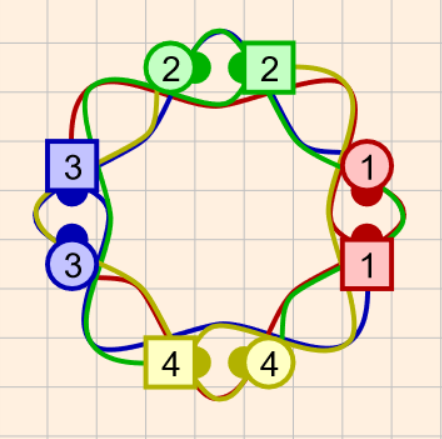
And here is some videos of this figure, the Scottish way (Grand Chain) and the Square Dance way (Right and Left grand).
Make sure you do also work on the other direction. So, the ones who were traveling clockwise should also practice traveling anti-clockwise. To do so, it is very easy: everybody goes back to their starting place, changes places with their partner, and beginning the same exercise with the same partner.
Our group now knows how to dance the Grand chain, but not yet the Right and Left through. We’ll get there step by step.
From the Grand chain to the circular hey
Divide the group in two circles, and repeat the exercise (grand chain). This is the next step, but it is also useful to support and guide any dancers who might have not yet fully understood.
Continue the exercise with increasingly smaller circles, until you have circles of four dancers. And there you have it: your dancers are now forming a grand chain with four dancers, known as a ‘circular hey’ in some repertoires.
Be careful to ensure they practise the circular chain in both directions; it becomes increasingly confusing as the size of the circle decreases.
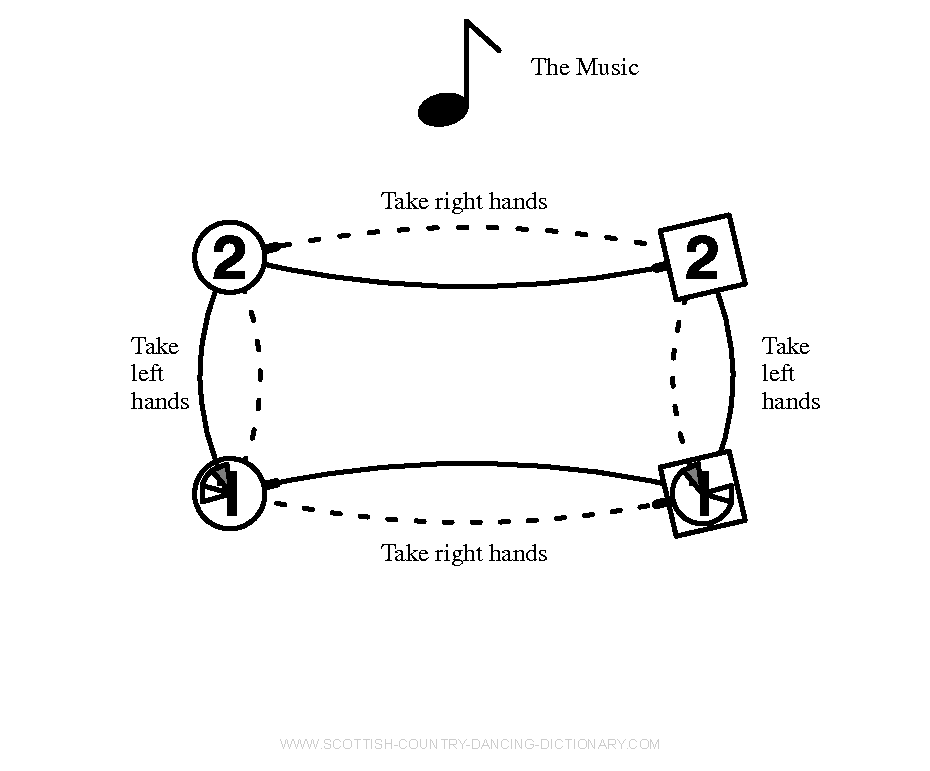
in the Scottish Country Dancing Dictionary
I complete the drawing with some videos, among the Scots and in England.
This move is extremely common in the English country dances, including Hambleton Round O that I already reconstructed. If that is all you need, then it is a good time to train your group to do 3 or 4 hand passes, and to perform the circular hey without hands.
If you are interested by the Right and Left through, then let’s continue!
And finally, the Right and Left!
To form the Right and Left, all you need to do is add a couple’s movement.
The principle is simple: the partners maintain their initial facing until they are side by side, then turn together to face the opposite couple.
For the Followers (usually the ladies), nothing changes. Really. If necessary, they can remain in their starting position until they take their partner’s hand. But generally, this comes naturally to them and there’s no need to spell it out.
For the Leaders (usually the men), we’ll add a small nuance. They, too, will remain in their starting position until they take their partner’s hand… and, above all, must not turn towards said partner. At the same time, as they offer their left hand to their partner, they’ll place their right hand on their partner’s back. This way, the two partners are side by side. As a couple, in this position, they’ll turn to the left – that is, the leader turns backwards and the follower turns forwards – until they’re facing the couple opposite them.
The same applies on the way back, and… there you go!
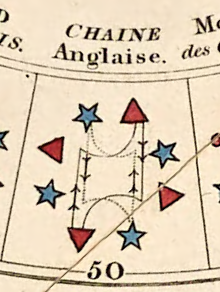
You will get a nice Right and Left, or Chaine Anglaise, in no time. Watch the figure in video for Historical (25-second mark), Square, and even traditional dance (French Brittany, without hands, 40-second mark)!
Une jolie chaîne anglaise. Cette fois, en images en danse ancienne (à 25 secondes), en square dance, et même en danse traditionnelle bretonne (à 40 secondes, et sans les mains)!
Conclusion: the foolproof method for teaching a figure
Here are a few tips to bear in mind, which apply to all explanations of all figure dances:
- Don’t get bogged down with names to begin with;
- Focus on instructions that apply to all dancers at the same time;
- Where possible, build the figure up bit by bit, using simpler ones as a basis.
And what about you – which figure do you find hardest to explain to beginners? (personally it is Strip the willow)
Do you have a tip for making it simple and easy to understand, or, on the contrary, is there a figure that defies all your attempts to explain it?
Let me know in the comments! Your experiences and tips could help other instructors get their groups dancing more easily.

You May Also Like

Which shoes for historical dance?
