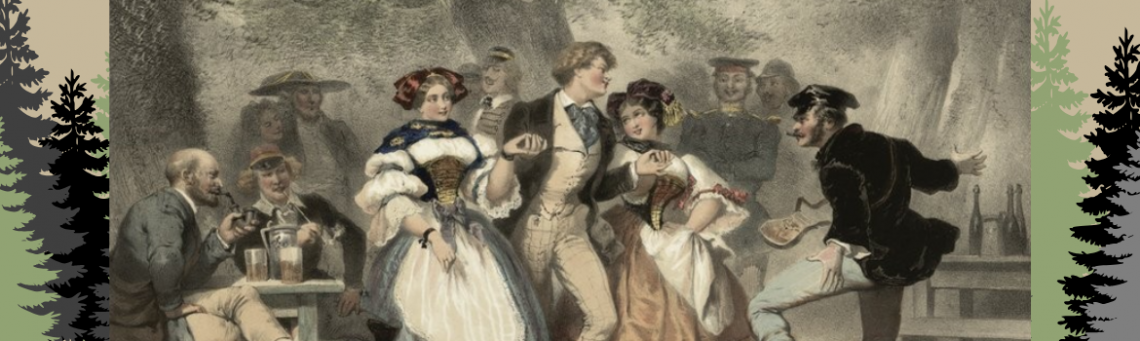
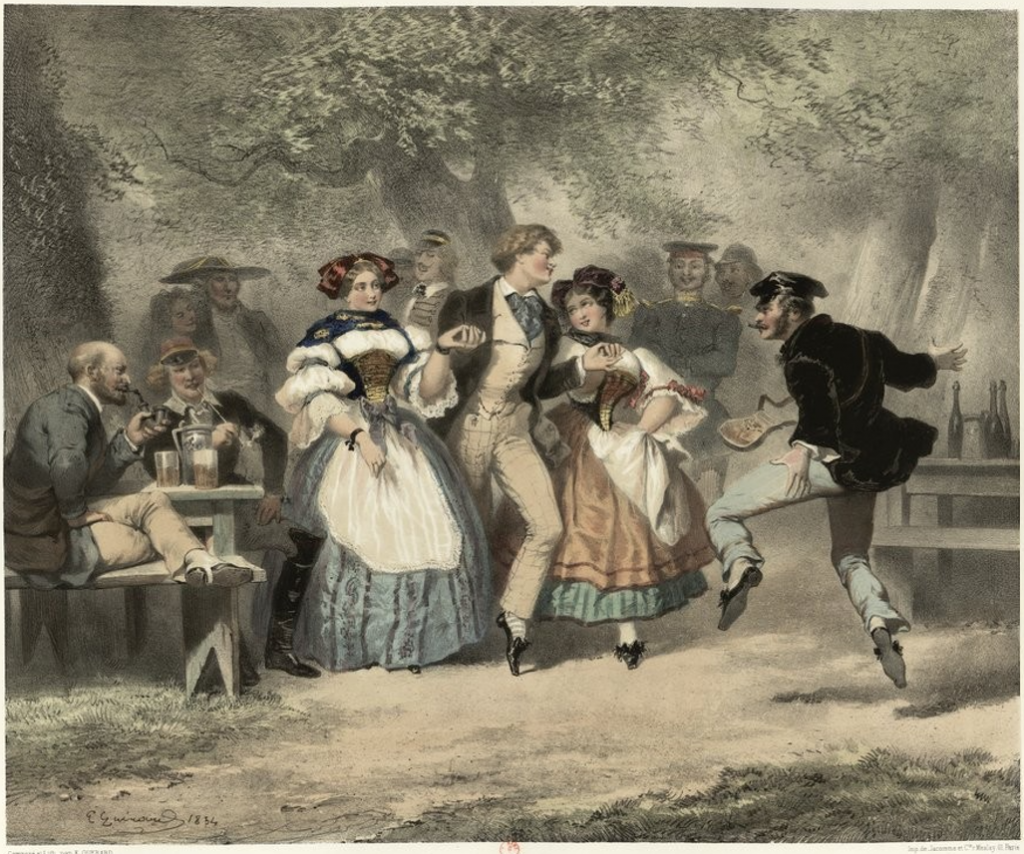
German beer and French dancing: “Le bal de vide-choppe”, 1854
The first Friday of August is International Beer Day. Not too related to historical dancing, you think… except in this amusing engraving: Les Touristes. Le Bal de vide-choppe (Heidelberg) [Teaching a Parisian dance | Deutsches bier mit Französischem tanz]. Translated as: The Tourists. The beer-drinking ball (Heidelberg) [Teaching a Parisian dance | German beer with French dancing]. As I like to analyse engravings, that comes just at the right time!
The creators
Let’s begin with identifying the creators. The lithograph is Eugène Charles François Guérard (1821 – 1866). He often painted crowded scenes, may it be at the bal Mabille, in the park or in the streets. Very early in his career, the artist born in Nancy worked closely with the publisher Goupil. He is, incidentally, the publisher of our artwork.
Adolphe Goupil (1806-1893) was an important art seller and publisher of the 19th century. Thanks to his associates, his business exapands from Paris to Dresden, Berlin, Brussels, The Hague, New York, Vienna… This explains that the series “The tourists” is multilingual. Indeed, the title is in French, with a subtitle in English and German.
“Les touristes” series
A quick word about the title. “Les touristes” (the tourists) echoes the democratization of tourism in the mid-19th century. The laboring classes began to travel, thank to the rise of railroad, the invention of package tour, and the success of seaside and spa resorts. Here, the tourists pay a visit to the “bal de vide-choppe” (litterally, the ball where tankards are emptied). That sets the tone: people come here to dance and have a drink. The title places this venue in Heidelberg, a city in Baden-Württemberg on the banks of the Neckar. It is a university town, but even back then people mainly visited it for its bucolic charm. Heidelberg has been accessible by train since 1840. As I said, trains and tourism go hand in hand…
Guérard’s ‘Les touristes’ series focuses, moreover, on the tourists’ experience rather than on the points of interest in the regions they visit. This was a major innovation, as up until then, travel albums had concentrated on monuments and characteristic landmarks.
The English subtitle, Teaching a Parisian Dance, emphasises the elegant dance imported from the French capital. The German subtitle, Deutsches Bier mit Französischem Tanz, draws a parallel between German traditions (beer) and French traditions (dance).
Dance and dancers
The depicted dance is easy to identify: this is the First Set (quadrille français). That particular position – a trio facing a man alone – brings to mind the Trénis, or (more likely in 1854), the Pastourelle. The two dancing men are complete opposites. Judging by his attire, the man on his own is a labourer. He strikes a dynamic, rather unconventional pose: with his legs and arms spread apart and bent, he is depicted mid-leap. Opposite him stands an elegantly dressed dancer: a fitted waistcoat, a cravat, a pocket watch and even striped socks. His posture is more restrained, his front foot pointed.
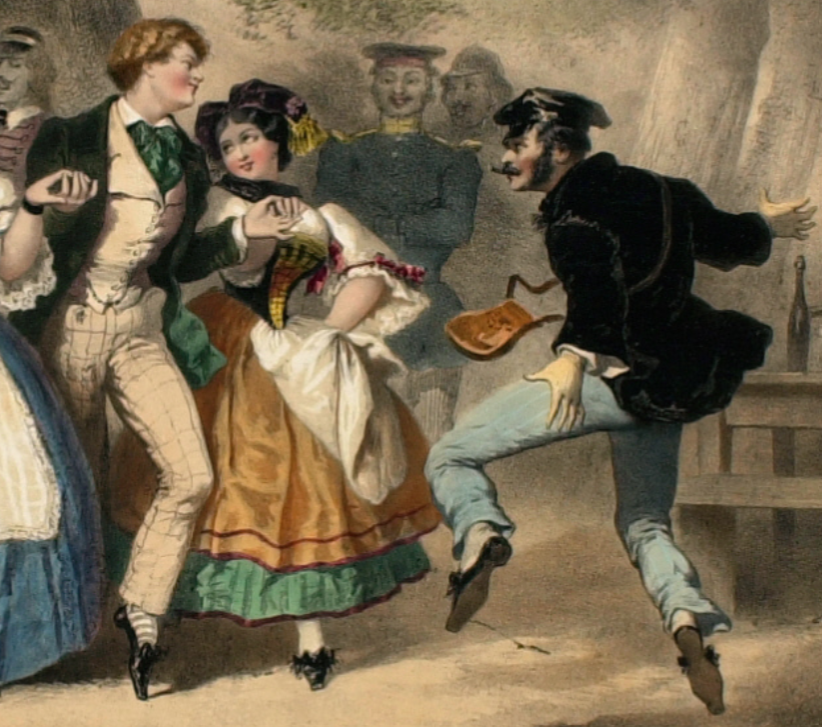
There is an interesting contrast between the two men. Indeed, the “guinguette” (open-air dance halls) provided an opportunity for a degree of social mixing between the working class and the petty bourgeoisie.
The dancing ladies
The dancing ladies wear a typically alsacian outfit. I search for a while a traditional outfit from Heidelberg, to show you the difference, unsuccessfully. The most famous outift from the region Bade-Wurtemberg is the bollenhut from the Black Forest: a hat with red pompoms. And the Heidelberg costume probably bore no resemblance to either of them, as the town is situated 115 km from Strasbourg (in Alsace) and 170 km from Gutach (in the Black Forest).
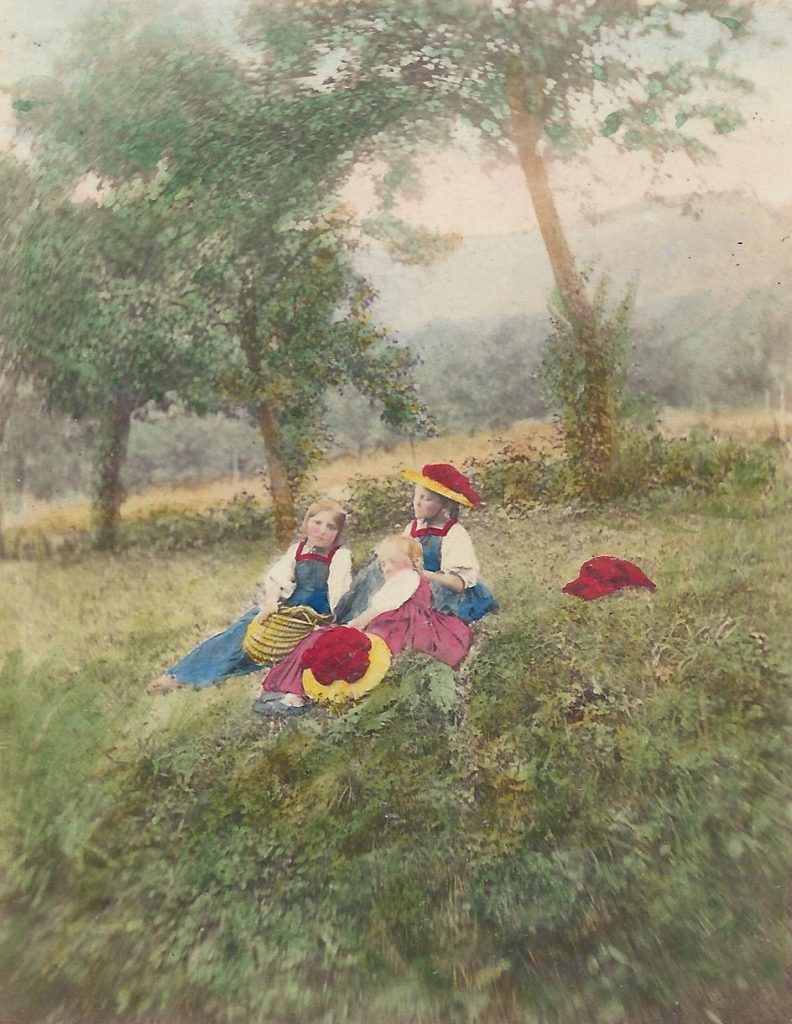
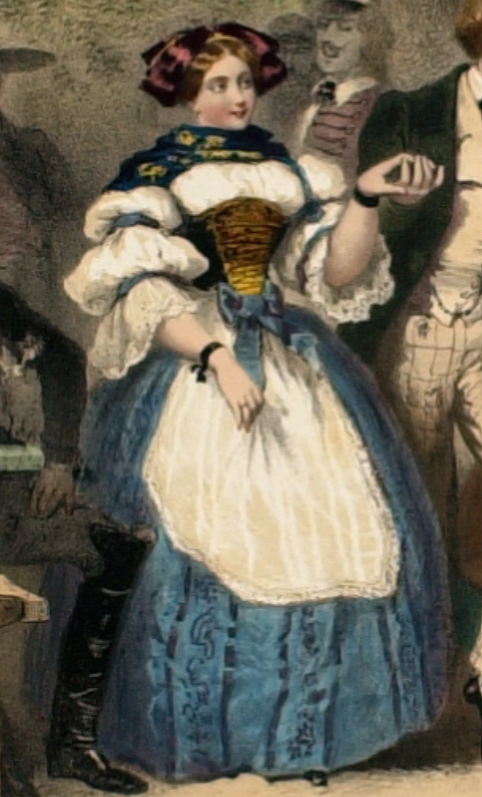
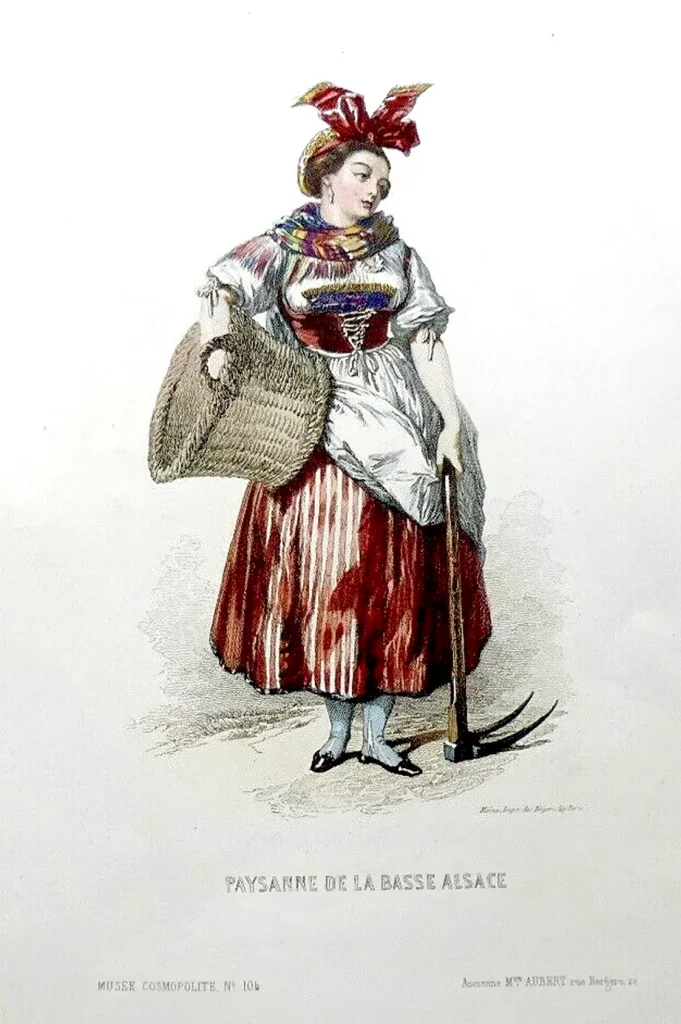
First hypothesis: Guérard doesn’t care about the accuracy of his characters’ costumes. He seems to think that one German costume is as good as any other – whether Alsatian or Baden – it doesn’t matter. But that would be surprising for an artist born in Nancy, in Lorraine. He must have been well acquainted with the local costumes. Hence my second hypothesis: the Alsatian women are tourists, too. And their presence could be interpreted as an affirmation of Alsace’s (and probably Lorraine’s) belonging to France.
I also think that the dancers’ outfits, which are more rural in style, contrast with those of the urban male dancers. For more information on Alsatian costume and its history, I recommend the excellent website ‘Costumes et coutumes d’Alsace’.
Audience at the beer-drinking ball
The disparity is not only between between the middle-class and the working-class, or between the city and the country. It exists also amongst the viewers. They are nearly all male, and wearing mostly uniforms.
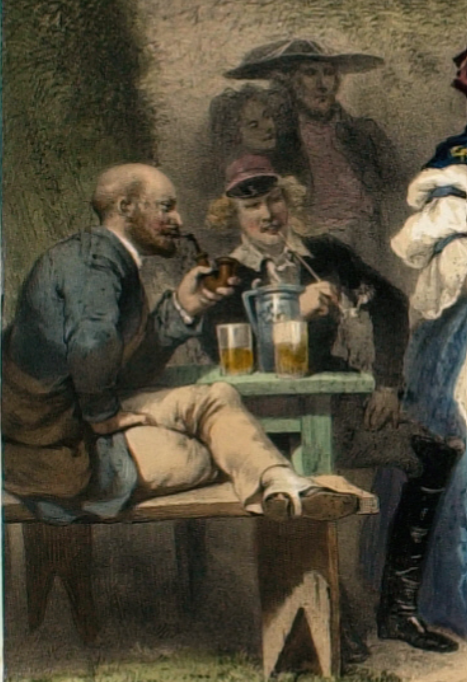
On the left, a middle-class man, in spats, smoking pipe. He may also be a tourist. [Edit 6/09/2026, based on the insightful observations of Catherine and Pascal Pécriaux] Opposite him, the man whom I thought I recognised as a member of the French infantry is more likely to be a German student. The French infantry wear similar kepis, but with a square visor, and they are much more particular about haircuts. Please forgive my ignorance regarding military uniforms. [End of edit]
Behind the soldier, a woman (we can’t see much more) snuggles againt a man with a large hat. He is maybe from Kochersberg, Alsace, according to this Joseph Wencker’s lithography circa 1860 (BNU Strasbourg NIM00927). The couple would then be also tourists.
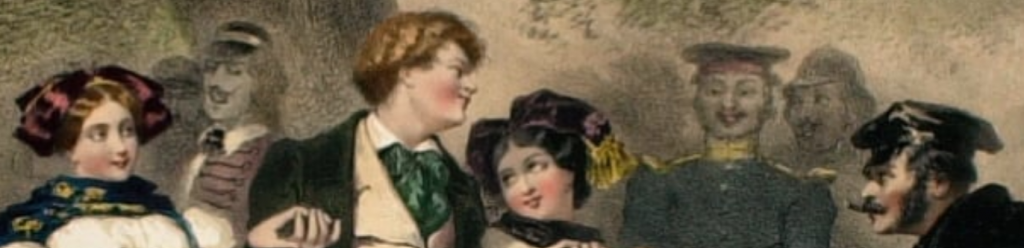
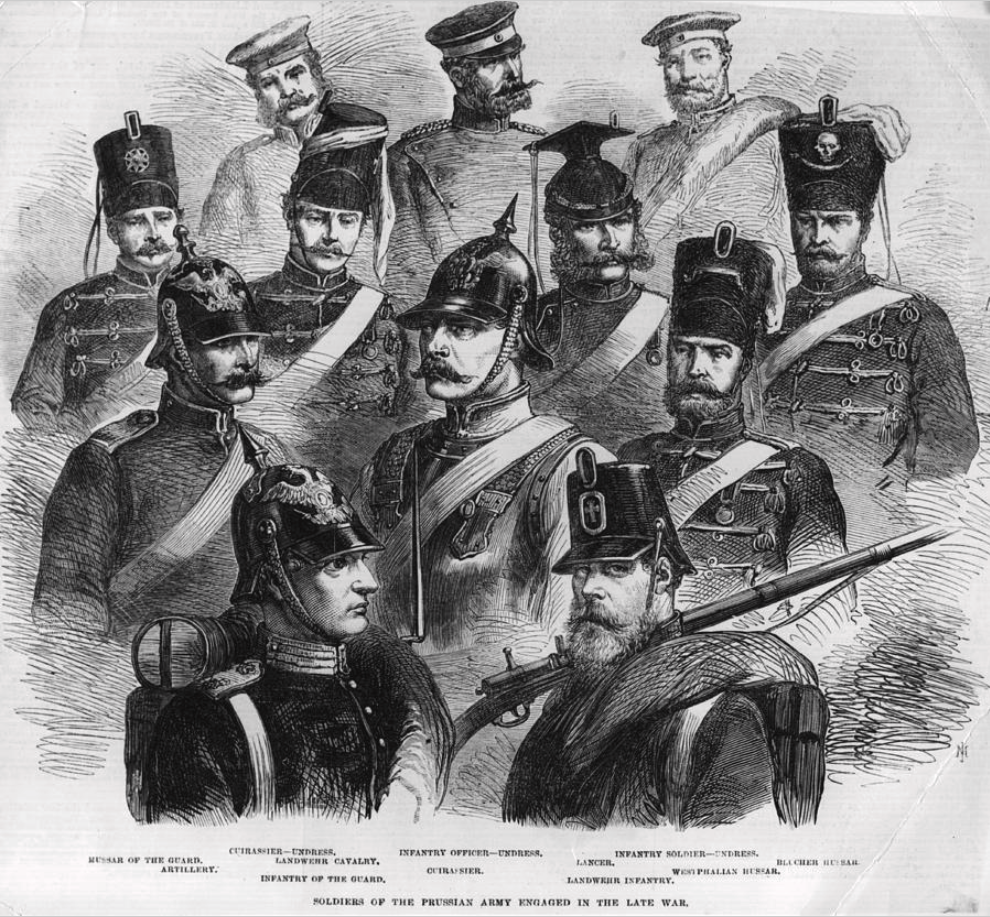
Between the dancers, from left to right, we see another man in flat-topped hat. Then a men in uniforme and cap (a hussar? a student?). Finally, a last one wearing a helmet that I couldn’t identify.
I must say that the Army and Univerity uniforms in the German confederation during the 19th cenutry are diverse and varied. An exemple herebelow:
Conclusion
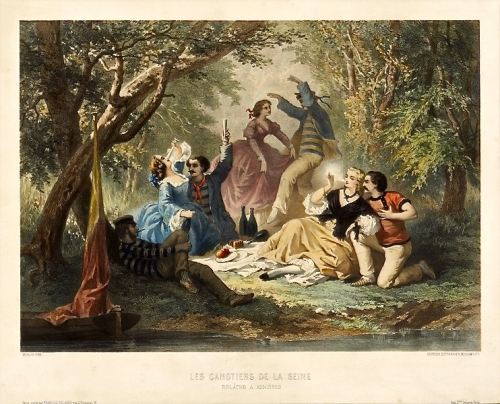
In any case, we see that the customers of the ball are mostly male, and diverse: soldiers, students, middle-class, working men… This motley crew is having a good time—drinking (note the bottles and mugs on the tables), dancing, smoking, and bantering. All of this takes place in a forest setting that is, I must say, quite pleasant. For the French tourists, it’s no doubt a chance to showcase their national art—dance—while sampling the malty delights from across the Rhine.
In this respect, this depiction of a guinguette is typical and foreshadows many others, such as this one:

You May Also Like
The Great Whales ball

A cotillion that causes a scandal
