Aéronette, a whirling waltz! – Part 1
Introduction
The Aéronette, a novelty dance from 1909, inspired mixed feelings to the ones who saw it danced. For example this lovely poem:
La danse nouvelle,
Mademoiselle,
La danse qui vous aguiche,
Ce n’est plus la matchiche :
C’est l’aéronette !
« L’aéronette », par Ascanio, L’Appel au Peuple de la Charente : organe de la République plébiscitaire, 10 octobre 1909, p.1.
The new dance,
Yound lady,
The dance that appeals you,
It is not the Maxixe anymore,
It’s the Aéronette!
The news regularly inspired social dancing. So, Boizot created the Quadrille de la Paix honouring the French-Sardinian alliance (1859). The high society is also an inspirationi for the choreograph: see the many coronation waltzes commemorating the crowning of British monarchs.
This time, it is a piec of sport news (should I say scientific? mechanical?) that inspires a “boston marché” (walking boston): Aéronette. This dance benefits from a media hype during its launching, in 1909.
This article is dedicated to my friends from Normandy, Sandra and Jean-Pierre.
Many thanks to Birte Hoffmann-Cabenda for locating some exciting German source!
The success of Aéronette
The topic
How did the choreographer Lefort and composer Bosc to give a maximal visibility (and thus success) to their creation?

Let’s first note that Auguste Bosc is not unknown. The composer from Montpellier (1868-1945) created the famous « Marche des petits pierrots ». Bosc began as the leader of the orchestra at Moulin de la Galette. He then founded his own ballroom, Bal Tabarin, in 1904.
Bosc and Lefort chose a burning topic in the 1909 news: aeronautics.
Indeed, since the late 19th century, there has been a veritable race for innovation in the field of aeronautics: need I mention Otto Lilienthal, Orville and Wilbur Wright, Clément Ader, and so on?
Depuis la fin du XIXe siècle, on assiste à une véritable course à l’innovation dans le domaine de l’aéronautique : dois-je citer Otto Lilienthal, Orville et Wilbur Wright, Clément Ader, etc.
But in 1909, aviation events came thick and fast.
On 25 July, Louis Blériot crossed the English Channel in his Blériot XI. The following month, the city of Reims hosted the very first air show. It was also in 1909 that Blériot and the Wright brothers opened their respective flying schools.
Aviation was therefore a promising theme for a new ballroom dance, Lefort and Bosc reasoned.
Their idea was widely emulated: numerous dances were published on this theme, both in France and abroad. Notable examples include two Aéroplanettes (Séréni, Follitt, both from 1910), the Pas des Aviateurs (Giraudet and Jouve, 1911), the Aeroplane Glide (Sheafe, 1913), and three Aeroplane Waltzes (Newman, Clendenen, Swayer, all three from 1914).

And when it is not a full stand-alone choreography, it is a variation of One-step, Maxixe or Tango that honours the aeronautics.
The dance masters’ convention
Choreographer Charles-Paul Lefort presented his Aéronette during the dance master’s convention of Paris in 1909. The convention approved it with enthusiasm, say several articles. It is not just any convention: it is organized by the Académie des maîtres de danse de Paris (aka ADMP).
Approval of a whole convention, that is a token of quality… right?
Attention, it’s time for a good dose of criticism. Let’s debunk that!
ADMP was created in 1904 by: Charles-Paul Lefort… The same man that proposed the Aéronette to the congress 5 years later!
Lefort was indeed the president of the ADMP in 1904, and kept this position until his death, in Verdun, November 27, 1917. Then his widow G.-C. took over. She published several dance books, such as « Les danses à la mode. Théories illustrées, Edition nouvelle, Paris, 1922 », « L’art de la danse » et « La danse de la valse au fox-trot ».
But let’s go back to Charles-Paul, the president of ADMP. He also got other creations approved by the congress, i.e. the Five-Step and the Chanteclerette.
It was easy for the president of the association to get his dances approved by his own congress.
Media coverag of the Aéronette
Fair or not, the strategy is winning. During Fall 1909, dozens of articles announced the nomination Aéronette by the congress. It seems that the newspapers received a description of the dance, reproduced verbatim for publication. The press release is sometimes accompanied by the journalist’s comments, which are by turns enthusiastic and mocking. But as they say, there’s no such thing as bad publicity.

La valse, dit-on, rapproche les couples du ciel, sans qu’ils quittent la terre… L’ « Aéronette » aussi, et c’est, peut-être, un avantage qu’elle a sur l’aéroplane ?
They say that the waltz brings couples closer to the heavens without them ever leaving the ground… The ‘Aéronette’ does the same, and perhaps that is an advantage it has over the aeroplane?
Le Matin, Nov. 19, 1909, p.2 « L’ ‘Aéronette’ » by J.L.
One article in particular caught my attention, as it combines a description, the musical score and illustrative engravings. It is ‘Une Danse Nouvelle: l’aéronette’, in the Annales politiques et littéraires, Nov. 7, 1909, no. 1376, p. 435. It is a sort of abridged version of the score.
The press release made its way beyond the Parisian press. Articles can be found in the French regional press (Saintes, Brest, Pau) and even the colonial press (Oran). L’Aéronette defies borders: it is talked about in Belgium, and as far afield as the United States! The dance master Rudolph Knoll, from Hamburg, even published a German translation of the dance, under the charming name of Flugzeug-Walzer (Airplane Waltz).
L’Aéronette even made it to the cinema, in a newsreel.
Sources for Aéronette
For once, there are plenty of sources for the Aéronette.
The score
Starting, of course, with the score. This isn’t available online, but I was able to access it thanks to the BNF’s digitisation services. For a small fee, and after a few weeks’ wait, the digitised version of the score landed in my inbox.
Imagine how eager I was to scroll through the pages on my screen!

C. Lefort (danse) et A. Bosc (musique), L’Aéronette. Boston marché (…), éd. A. Bosc, Paris, 1909.
Imagine my disappointment when I discovered that there was no description of the dance accompanying the score. This was despite the reference to ‘théorie de C. Lefort’ on the cover.
I felt so disheartened that I stopped writing altogether for several days. When I finally returned to this score, I decided to make the best of it.
Granted, there is no description. But the cover features some interesting illustrations: five drawings depicting the five figures of the dance. Thanks to the score, I also know the number of bars allocated to each of these figures.
Finally, an intriguing note states that ‘for the cinema’, the last 16 bars of the ‘on plane’ figure are to be cut. I’ll come back to that.
Time for the article’s funny but pointless remark. The score is dedicated to the choreographer’s wife: ‘To Madame C. Lefort. A warm tribute from the Composer’. Not very romantic, this Lefort!
Articles in the newspapers
As the score doesn’t mention the dance steps, I rely on the press. As the text is almost identical in all newspapers, I’ll assume that this is the original set of instructions written by Lefort.
1° Le départ. Les danseurs se tiennent comme pour toutes les danses tournantes et font, sur deux mesures très accentuées, des temps de galop en avant imitant ainsi le roulement de l’aéroplane.
2° On est parti. « L’aéroplane se met en vol ». Les danseurs à ce moment ont un mouvement des bras de bas en haut imitant ainsi le vol d’un oiseau, ils font ensuite quelques petits pas marchés.
3° On vole et 4° On plane. « L’aéroplane est en l’air » : pas très glissés en balançant légèrement les bras, imitant ainsi l’aéroplane cherchant à trouver son aplomb, ce mouvement se continue plusieurs fois.
5° On atterrit. Pour terminer, « descente de l’aéroplane », imitée par les danseurs se jetant vivement d’un pied sur l’autre, en inclinant la tête légèrement en avant.
1° The departure. The dancers hold each other as for all the turning dances, and do, on two very accentuated measures, some galop time, forward, imitating the taxiing of the plane.
2° We’re gone. “The plane takes off.” The dancers at that moment make a move with the arms from bottom to top imitating the flight of a bird, they then do some little walking steps.
3° We’re flying and 4° We’re gliding. “The plane is up in the air”: very sliding steps lightly swinging the arms, imitating the plane pitching to level off, that move is continued several times.
5° We’re landing. To finish, “descending of the place”, imitated by the dancers shifting from one foot to the other, tilting the head slightly forward.
Press pictures
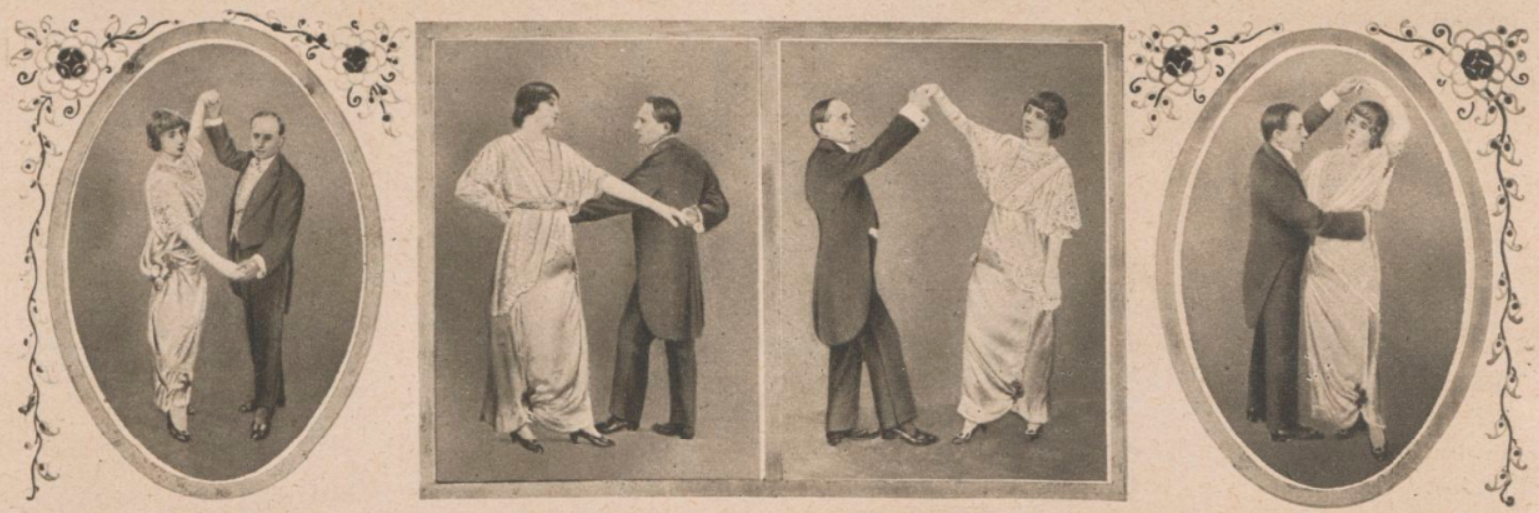
I must add something to the drawings on the music score cover: four pictures, published in L’Afrique du Nord illustrée, Dec 4, 1909, p.11.

The first one, titled « en avant » (‘Let’s go’), matches the drawing « le départ ». Then comes « on s’enlève » (‘We’re taking off’), similar to the drawing « on est parti ». The next two pictures are entitled « L’ ‘Aéronette’ du maestro Bosc est aussi gracieuse qu’élégante » (‘Maestro Bosc’s Aeronette is as graceful as elegant’).

The fourth picture illustrate “on vole”. Like the others, it looks a lot like the drawings on the music score. The third one show a never-before-seen position. Dancers stand side by side, arms stretched to the sides, quite low. They are bending the knees and are maybe leaning forward. I identify this figure as “on atterrit”.
Cinéma
Last but not least, our last source is audiovisual (click to watch on Youtube). This a newsreel, selected in Paris mil neuf cent : chronique de 1900 à 1914 by Nicole Vedrès. This documentary released in 1947 features excerpts from over 700 movies.
That clip shows a club or a dancing café. A couple is dancing Aéronette. The woman wears a headpiece reminiscing of the wings of a plane. This headpiece is similar to the one we see on the music score. The dancers could well be the Lefort, if we believe that picture.
I don’t know the exact source of that document.
Conclusions and reconstructions of Aéronette
For once, the dance historian has a lot of sources under the hand. So we can expect a precise and detailed reconstruction.
But, that article is already very (too) long. So I will expose my reconstruction proposal in the next articles. See you soon then, to analyse the sources, and to reconstruct the dance.
Until then, take care, and dance!


You May Also Like

Military Dip Waltz, a novelty dance for 1903

La Westendaise, a novelty dance by J. Quesnel