
How did people learn and practice dancing, before the American Revolution
1770, a wedding in a little village of North Caroline: they hold a ball, of course!
Dance has always been an integral part of family and social celebrations. The 13 colonies of North America were no exception. But…
- How did British colonists learn to dance in the late 18th century?
- What opportunities did they have to dance?
- How did they organise a ball at the time?
In this series of articles devoted to dance in the 13 colonies, I will attempt to answer these questions (and many others!). Here, we will focus on the practical side of dancing. Because it’s all very well to know what to dance, but you still need to know how and when to dance. Next, we will look at the political message conveyed through dance.

Learn to dance
Lessons from a very young age
Dance is a part of the standard curriculum in the European aristocracy, just like mathematics or reading. Learning how to dance the minuet was seen as just as important as knowing hos to ride a horse. Imagine that! It is as if today, mastering the slow dance was as important as to drive a car.
Aristocracy sees dancing as important because it divides people, it sets some people apart. The ones who had the time and money to learn the reverence, the minuet and the good manners tood out from ordinary people.
In aristocratic circles, dance lessons began at a young age, around five years old. In rural areas, a travelling dance master would be welcomed into the home for a few weeks. The master would teach the children of the house, their friends, family and neighbours every day. Lessons therefore took place at home.
No one hesitated to call on everyone in the house to complete a set or a quadrille: parents, servants and even slaves were called upon to help!
After a while, the dance master would leave for another house. He would return periodically to check on his pupils’ progress.
In large cities, some dance masters settled down and opened dance schools. Students then went to the teacher for weekly lessons. This phenomenon of dance masters becoming ‘sedentary’ became widespread in large cities after the American Revolution.
Lessons for adults
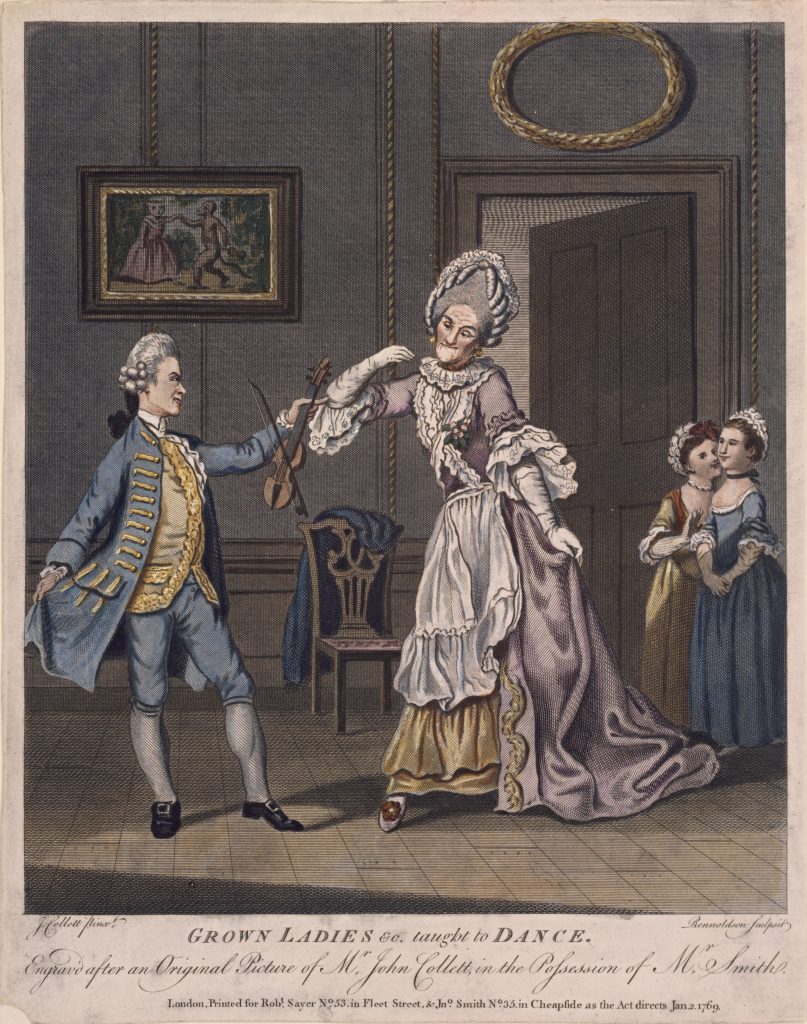
Note that the dancing master teaches dancing to children, but also to adults. The demand for adult classes rise considerably at the end of the 18th century.
Indeed, thanks to social mobility, many people are moving into more affluent social classes. They were unable to learn the codes of aristocratic behaviour during their youth, which closes many doors for them. The ‘new rich’, now adults, therefore approach dance teachers, who are only too happy to expand their clientele (I will come back to this later).
These new types of students were a source of delight for the caricaturists of the time – and for the other students: look to the right, at the whispered conversations!
Opportunities to dance
The family evenings
Once one knows how to dance, one must practice. The most common opportunity to dance was the “family evenings”.
Today, this expression evoques rather a movie on TV, a boardgame or a reading by the fireside. At the time, it was common that the older sister sat at the piano, or that the father took his violin, to play some country dances for the rest of the family.
Those evenings were quite short: just enough to fill the time between supper and bedtime. The participants are always the same: occupants of the house, maybe some occasional visitor. And the repertoire is not big: the family musician can only play some tunes.
That kind of evenings is depicted in Jane Austen’s novels.

Pride and Prejudice, Simon Langton, 1995.
The private ball
An more enjoyable, but less common occasion to dance, is the private ball.
Wealthy families took part in an actual season of balls, usually during winter.
Each house organized its own ball in turn. A little ensemble, a quatuor for example, would play the music. The private balls usually began around 6 PM, and would only finish at dawn. A sit-down supper, served between 10PM and midnight, helped everyone to perk up.
This was the perfect occasion to see friends and neighbours again, as well as visitors. Private balls were also held to celebrate engagements, weddings, births, etc.

Outlander, Season 5, ep. 6, 2020.
The public ball: the Assemblies
I already spoke a bit over the Assemblies. This is an society aiming to organize social events: lectures, concerts, game nights… and of course, balls. You could nearly think of it as an events committee.
The members of the society paid a contribution, that allowed them to attend the events of the season. Events that could be balls, held monthly or yearly.
The local Assembly was a unique place for socialising. At the time, most leisure activities took place at home, in private. However, the Assembly was a public place where women and men could meet in a respectable manner. It was THE place where wealthy singles would meet.
Assemblies existed in every town. Their rules, which were sometimes very specific, provide valuable information for historians. In large towns, Assemblies had a dedicated venue for their activities, with a large hall and smaller adjoining rooms for tea, meals and card games. In the provinces, Assembly meetings tended to be held in the best inn in the area.

Other public balls… Out-of-the-ordinary ball
Sometimes, cities or public institutions organise balls for special occasions. The tradition of a presidential inaugural ball did not yet exist, but…
In England, the monarch’s birthday was celebrated. After their independance, the United States carried on that tradition, transposing it onto their national hero: George Washington. That’s why many American cities organised public balls on February 22nd. And that’s just as well, because February was already the ultimate month of balls.
The young country was therefore continuing a centuries-old English tradition.
The role of the dance master
This role of dance master, or master of ceremonies, was very important.
First of all, as I mention earlier, he taught the dance to children and adults. But his role has the uppermost importance during the balls.

His mission: to check the identity and the social rank of each person attending. Based on this information, he assigns the partners and the order of precedence of the couples for the minuet.
This task may seem trivial to you. But in a society where social rank is taken very seriously, one cannot afford to make a mistake in the order of precedence. Who would want to ‘lower’ themselves to dance with just anyone? What’s more, dancing often leads to marriages. So it’s best to protect one’s reputation.
Dance masters are mainly found in towns and on large estates. In the countryside, there are a few fiddlers who play and call out the dance steps at the same time. Dance masters often have a second job (luthier, musician, cabaret owner, or even street paver.
After the French Revolution, many French dance masters arrived in the United States. Their usual clientele, the nobility, was no longer so able to dance. This influx of dance professionals led to a twofold change, due to increased competition between the masters.
On the one hand, the job became more professional. From then on, dance masters would be solely dance masters. On the other hand, some dance masters moved to smaller towns or even the countryside in search of new clients. As a result, new choreography spread more quickly to the western part of the country.
Dancing during the war
After the signing of the Declaration of Independance in 1776, conflicts with England multiplied and dragged on. The War of 1812 (which ended in 1815) marked the definitive end of British claims on its former 13 colonies. Between 1776 and 1815, wars followed one another.
How did wars influence dance?
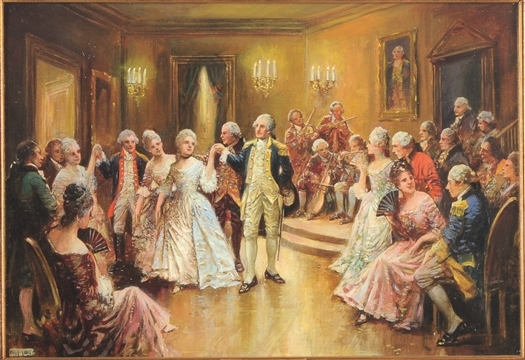
Actually, the influence of the wars on the dancing habits was limited. Many balls were held in New Jersey – at the hart of the battle. Officers of both sides regularly attended balls (not the same balls, of course).
They also often went to the theater. Know that the theater shows of the time implied musical intermedes and a final ball.
Conclusions
The American society of the end of the 18th century was very attached to dancing. It was part of the standard education of high society. It was a sought-after quality: it is through dancing (especially the minuet) that marriages are formed.
But beyond its matrimonial function, dancing also served a socialising and entertaining purpose. Opportunities to dance were multiplying everywhere, and everyone wanted to dance often. It is therefore not surprising that political debates are centred around dancing.
Political debates? To find out more, read the following article.

You May Also Like

What did people dance in the 13 colonies?

The allemande, a dance throughout centuries
